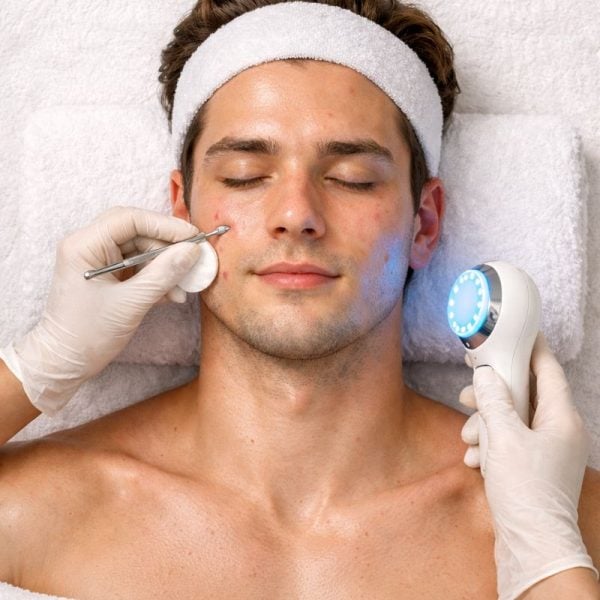
Acne treatment: from impurities to a more stable, calmer skin
Acne is rarely “just a few pimples”. It is a recurring process or blockage, inflammation and recovery that takes place mainly in the T-zone for some people, and on the jawline, back or shoulders for others. What makes it extra frustrating: you can try a lot, but without the right approach it keeps coming back.
Professional acne treatment therefore does not focus on quick solutions, but on a well-thought-out, structural approach. Not a standard protocol, but a conscious investment in skin health.
Make an appointment with an acne specialist in Amsterdam
Are you considering this treatment in Amsterdam?
Leave your details for more information.

The best acne clinics and beauty salons in Amsterdam
What does a professional acne treatment actually deliver?
A professional acne treatment not only works on what you see in the mirror, but also on the processes that maintain acne. That difference determines whether your result remains temporary or gradually stabilizes.| What the treatment does | How it works & what you notice |
|---|---|
| Reduces active inflammation |
How it works: The treatment calms inflammatory processes in the skin. What you notice: Less redness and swelling; the skin looks calmer and calmer. |
| Keeps pores cleaner |
How it works: Excess sebum and impurities are effectively removed. What you notice: Fewer blackheads and a cleaner skin feeling. |
| Better balances sebum production |
How it works: The skin gradually learns to maintain a more stable fat production. What you notice: Less shine and less greasy feeling skin. |
| Makes the skin less reactive |
How it works: The skin barrier is supported, so that stimuli are better absorbed. What you notice: Less sudden flare-ups and tenderness. |
| Accelerates the recovery or impurities |
How it works: The skin receives support in its natural recovery process. What you notice: Spots heal faster and feel less painful. |
| Improves the skin structure |
How it works: The skin renews itself more evenly and becomes less clogged. What you notice: Smoother skin that feels less bumpy. |
| Helps prevent scar formation |
How it works: By calming inflammation in a timely manner, damage to the skin is limited. What you notice: Less chance or permanent scars or thickenings. |
| Provides a more even complexion |
How it works: Active redness decreases and the skin becomes better balanced. What you notice: Less color difference and a more even skin tone. |
| Improves skin comfort |
How it works: The skin barrier becomes stronger and better hydrated. What you notice: Less tightness and irritation, more comfort in everyday life. |
| Provides more control and confidence |
How it works: The treatment is tailored to your skin and supported with a clear routine. What you notice: More control over your skin condition and less frustration due to recurring complaints. |
Who is acne treatment suitable for?
Eligibility by profile
- Men: often thicker skin and higher sebum production; pathways more often focus on sebum regulation and inflammation control.
- Women: more frequent hormonal patterns (chin/jawline); combination or inflammation inhibition and barrier repair is often key.
- Young people: comedones + inflammation; consistency and mild build-up prevents aggravation and scarring.
- Adult acne (25+): often persistent, with sensitivity and residual stains; dosage and maintenance are crucial.
Skin types and sensitivities
Acne treatment can be suitable for any skin type, provided the method is tailored to sensitivity, barrier status and pigment sensitivity.
For tanned skin types, it is extra important to avoid aggressive stimuli that can provoke discoloration.
Contraindications
Absolute
- Active skin infections in the treatment area
- Open wounds or severe skin damage
Relative (only with extra caution)
- Severe rosacea or highly reactive skin
- Tendency to hyperpigmentation (especially with aggressive peels)
- Active eczema flare-ups
Temporary
- Recent use or strong medication that makes the skin extra vulnerable (only treat after professional judgement)
- Just started using powerful active products, which makes the barrier still unstable
How acne treatment works and what methods are available
“Acne treatment” is a collective term. Two people with acne can have completely different causes and skin reactions. That's why a professional approach is key diagnosis at skin level: what is primary — blockage, inflammation, sebum, barrier, or a combination?
Underlying causes that determine the approach
- Constipation (comedones): pores close by dead skin cells + sebum.
- Inflammatory dominant: red, painful, rapidly spreading; risk or scarring.
- Hormonal Triggers: often chin/jawline, cyclical course.
- Barrier issues: acne + sensitivity/irritation due to overtreatment or wrong routine.
- Acne on body: friction, sweat, thicker skin, different product choice required.
1) Manual acne treatment (extractions)
Manual extraction is controlled removal or comedones (blackheads/blockages) by means or a deep cleaning. This can be effective when blockages are the main factor. The art is there dosing: Working too aggressively actually increases the risk or redness, damage and spots.
- Suitable for: comedones, subcutaneous blockages, mild acne without much active inflammation.
- Strengths: Immediately “cleaner” skin appearance, clearing pores, preparation for follow-up treatments.
2) Chemical peels (such as salicylic acid and glycolic acid)
Improving skin renewal reduces the "stickiness" or dead skin cells in the pore, this can be done by means or : peels. A Salicylic Acid peel (BHA) is fat-soluble and can therefore be effective against congestion and sebum. Glycolic acid peel (AHA) can help with texture and residual stains.
- Suitable for: recurring blockages, dull skin with impurities, post-acne spots.
- Strengths: structural improvement, fewer new blockages, more even complexion.
3) LED light therapy (blue and red light)
LED is a supporting method that mainly works on inflammation and bacterial activity. Blue light from the Collagen Booster can also be used, for example, to reduce acne-related bacteria; red light to calm inflammatory responses and support recovery.
- Suitable for: inflammatory acne, sensitive skin, support after cleansing or peeling.
- Strengths: non-invasive, little recovery time, easy to combine.
4) Mechanical deep cleaning (hydradermabrasion / vacuum cleaning)
Mechanical deep cleaning combines cleansing, mild exfoliation and often a controlled vacuum action. The goal is to cleanse pores without aggressive pressure. This can be especially helpful for people who get red easily or for whom manual extractions cause too much irritation.
- Suitable for: sensitive acne, superficial congestion, maintenance between more intensive steps.
- Strengths: clean, fresh skin feeling; less chance or “after-effect” than with heavy extractions.
5) Energy-based methods (laser / clinical technology)
In some settings, energy-based technology is used to influence inflammation or address residual damage (such as redness/pigment). This requires extra expertise, correct indication and realistic expectations.
- Suitable for: persistent inflammation or post-acne redness/pigment (depending on skin type).
- Strengths: can tackle stubborn components where basic steps are insufficient.
Why combination protocols are often the most effective
Acne is rarely one problem. That's why a combination or things works cleaning (blockage), regulate (sebum/keratinization), calm down (inflammation) and restore (barrier) in practice the most predictable. A good protocol does not feel "intense", but it is well thought out: sufficient incentive to improve, sufficient rest to recover.
Results and expectations: what do you see when?
Results with acne usually occur in phases. The goal is not just a temporarily calm moment, but a skin that is less likely to go off the rails. How quickly you see improvement depends on your type or acne, sensitivity, routine and choice or treatment.
After 1–2 treatments
- The skin often feels cleaner and less congested
- Inflammations can become calmer (especially with LED/calming steps)
- You usually get clarity about triggers and what your skin can tolerate
Please note: in some people the skin may react temporarily (e.g. because blockages “emerge” or because the skin has to get used to it). That's not the same as “it doesn't work” — the interpretation requires expertise.
After a complete course (e.g. 4–8 treatments)
- Less frequency and intensity or outbreaks
- More stable sebum balance and less recurring constipation
- Smoother skin structure and less “roughness”
- Fewer residual spots because inflammation recovers faster
This is the point where many people feel the difference between “I'm trying everything” and “I have a plan that works.”
What does which method typically contribute?
- Manual extractions: instantly cleaner pores, especially with comedones; maintenance is important.
- Peelings: fewer new blockages and more stability; results build up progressively.
- LED: calmer inflammation and faster recovery; strong as a supporting step.
- Mechanical deep cleaning: fresh, clean skin feeling with less irritation; ideal for sensitive skin.
- Combinations: often the most “sustainable” because multiple causes are tackled simultaneously.
How do you maintain results?
Acne often has a recurring character. That doesn't mean it's hopeless, but it does mean that maintenance and routine are part or success. Professional guidance helps to limit relapses and make timely adjustments when hormones, stress or seasons influence the skin.
Frequently asked questions acne treatment
+What is the difference between manual acne treatment and equipment?
+Is acne treatment painful?
+How many treatments are needed?
+Can acne worsen after the first treatment?
+Is acne treatment suitable for men?
+Does acne treatment work for adult acne?
+Can you cure acne completely?
+Is there recovery time?
+Can I wear make-up after treatment?
+How much does an acne treatment cost?
+Is equipment always better than manual?
+Does an acne treatment help against scars?
+Can I choose which method I want?
+Where can I find reliable acne specialists?
Acne, recurring blemishes or inflammation? This requires a professional approach
If acne keeps coming back, it is usually not a lack or discipline, but a sign that the approach is not well suited to the cause in your skin. Surface solutions can help temporarily, but often lack the combination or cleansing, regulation and barrier repair needed for stability.
Do you want to know which method makes sense for your skin type and acne pattern? Then compare specialists who work with professional protocols and choose based on expertise — not on promises.
View affiliated salons in Amsterdam or compare specialists in your area and discover which acne treatment suits your skin.